


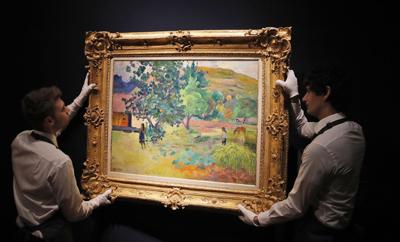
I’m going to do something I’ve never done before in this column: I’m going to recommend a book whose author occasionally muffs it. Don’t get me wrong, “Wild Thing� — the new biography of Paul Gauguin by Sue Prideaux — is perfectly intelligible, but every now and then one of Prideaux’s sentences comes down the pike with a needless subordinate clause rattling along in its wake like an old tin can. Normally this would cause me to return a book to the library unread, but despite the occasional bump and pothole, the road Prideaux took me down so fascinated me I soon found I couldn’t wait to follow it further.
“Wild Thing� is the title, but I think “Sad Thing� would have been more appropriate. Gauguin’s life was one long rush from catastrophe to catastrophe. For me at least, it was, oddly enough, this endless downward spiral that made Prideaux’s book so captivating. Again and again I wondered if things could possibly get any worse … and then they did. Despite the best of intentions, Paul Gauguin always managed to leap from frying pan to fire.
As if to accentuate just how bad his life would become, it started off well: a beautiful Danish wife, Mette, whom he loved, sweet children, a happy home and a successful job as a stockbroker that left him flush with cash. Enjoying himself, he took up painting as a hobby, began to mingle with artists and playwrights.
But when the French stock market crashed in 1882, Gauguin’s firm went belly-up and he found himself without a sou. With no funds for food or rent, the artist took his wife and children to Denmark to live with Mette’s parents. Desperate to help support his family, Gauguin talked a Parisian manufacturer of tarpaulins into making him their salesman in Copenhagen. Small problem. Gauguin spoke no Danish.
When the locals proved uninterested in tarps being sold by a man whose language they couldn’t understand, Mette’s family grew disapproving and relegated Gauguin to an unheated attic room, where the artist moldered — cold, miserable and ill. Prideaux’s book is lavishly illustrated, and the self-portrait Gauguin painted at this time makes him look like a famine victim: thin, dejected and sitting in a room so small he would bump his head if he stood up.
When the artist’s sister bragged of the bank her husband was opening in Panama to serve the French effort to build a canal across the isthmus, Gauguin borrowed money to sail there, certain his experience as a stockbroker would land him a good paying job working for his brother-in-law. But upon reaching Central America, he found the bank his sister had boasted of was nothing more than a general store — a general store that wasn’t bringing in enough cash to sustain even its proprietor.
With little choice in the wilds of Panama, Gauguin took a job as a workman on the canal dig itself, wielding pick and shovel for a pittance — whereupon he quickly contracted malaria, a disease that would plague him the rest of his life. As if that weren’t bad enough, in true Gauguin form, the French effort to build the canal collapsed within weeks of his hiring and, once again, he was left stranded and penniless in a foreign land.
On another occasion, seeking — as he would most of his life — the lost innocence of a more natural, primal setting, Gauguin moved to the then remote province of Brittany. On a visit to the small fishing village of Concarneau, he was set upon by a group of men who took offense at his bohemian appearance. Wearing wooden shoes, they very nearly kicked him to death, leaving him unconscious, his tibia protruding from the skin of his lower leg, his ankle bones shattered. Local doctors inexpertly closed the wound and tried to set the leg, but he would be lame for the rest of his life and suffer persistent suppurating lesions on that shin.
I have listed here just three of the calamities that befell Gauguin, leaving out the two that are the most famous: his stay with Vincent Van Gogh in Provence and, later, his attempts to find solace in the South Pacific. I thought I knew a fair amount about these episodes, but reading Prideaux’s book I discovered much of what I knew was wrong.
Contrary to the image I had of their relationship, Gauguin was a true friend to Van Gogh, corresponding with him throughout his life and, after his suicide, planting sunflowers in Tahiti as a memorial to the artist — this despite the fact the painter of “Starry, Starry Night,� mad and intent upon murder, once pursued Gauguin through the streets of Arles with a straight razor.
And reading about Gauguin’s sojourns in the Marquesas and Society Islands, I quickly had to set aside the notions Hollywood and James Michener had given me of Polynesian sexual mores before the advent of Western European prudery. If Prideaux’s take on the subject is right, the culture that Capt. Cook and other early explorers discovered in the South Pacific was characterized less by free love than pedophilia and infanticide, among other horrors.
Not that the Western Europeans replaced that culture with anything better. The French administration of Tahiti and the Marquesas was as exploitative and cruel as most (all?) colonial enterprises. And once again contrary to the modern image we have of him as a man who took advantage of the privileges conferred upon him in those islands by his race, Gauguin made himself dangerously unpopular with that administration, writing long newspaper articles exposing the French colonial government’s sins against the Polynesians it claimed to serve.
Living on the remote island of Hiva Oa, reduced by poverty, malnutrition and disease, Gauguin passed away in 1903 at the age of 54. He died as he had lived, penniless, alone, and more or less forgotten by the art world. Yet despite all the misery, the man continued to paint, sculpt and write to the very end, producing a body of work that, more than a hundred years later, still holds the power to astonish us.
And once again a book from the Talbot County Free Library has managed to upend Bill Peak’s many misconceptions.


(0) comments
Welcome to the discussion.
Log In
Keep it Clean. Please avoid obscene, vulgar, lewd, racist or sexually-oriented language.
PLEASE TURN OFF YOUR CAPS LOCK.
Don't Threaten. Threats of harming another person will not be tolerated.
Be Truthful. Don't knowingly lie about anyone or anything.
Be Nice. No racism, sexism or any sort of -ism that is degrading to another person.
Be Proactive. Use the 'Report' link on each comment to let us know of abusive posts.
Share with Us. We'd love to hear eyewitness accounts, the history behind an article.