


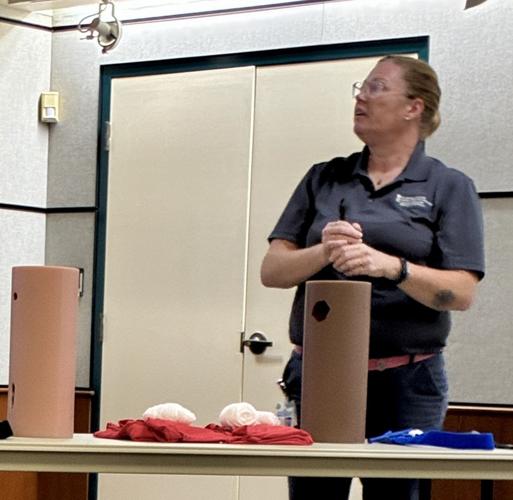

DENTON — In the minutes before emergency crews arrive, a bystander can be the difference between life and death. Severe bleeding can become fatal in as little as three to five minutes, while emergency response in Maryland typically averages seven to ten minutes. In rural and farming communities, that gap can be longer.
“Citizen response can make the difference between life and death for a family member, friend or neighbor,� said Emergency Medical Technician Rachel Cockerham, Stop the Bleed coordinator for the Center for Injury Prevention & Policy at the R Adams Cowley Shock Trauma Center.
Cockerham is leading community Stop the Bleed classes across the state that empower residents with the skills to control severe bleeding before emergency responders arrive. She gave one of these classes at the Caroline County Public Library in Denton Oct. 17.
There, she explained that the Stop the Bleed initiative grew from national efforts to prevent avoidable deaths from uncontrolled bleeding following tragedies such as the Sandy Hook Elementary School shooting in 2012 and the Boston Marathon bombing in 2013. In 2015, during the Obama administration, the White House called on the American College of Surgeons and the Department of Defense to collaborate on training the public to save lives by controlling bleeding.
The course highlights uncontrolled bleeding as the leading preventable cause of death after trauma. While Maryland benefits from a strong prehospital care system and seven regional trauma centers, emergency response in rural areas often depends on a combination of paid and volunteer staffing. In remote fields, wooded areas, or hunting sites, response times can be extended, making citizen intervention critical, Cockerham said.
To reach residents in rural parts of the Shore, The Mainstay in Rock Hall will host a free Stop the Bleed training led by trauma specialists from Shock Trauma on Sunday, Nov. 2, from 2 to 3 p.m. Organizers noted that the nearest hospital is more than 15 minutes from most Kent County locations and that paramedics may be responding elsewhere when an emergency occurs.
The event is free and open to the public as a community service. Seating is limited to the first 40 participants, and online registration is required. To register, visit or go to and follow the pop-up link.
The ABCs of bleeding control
Participants in the training learn the program’s three key steps — Alert, Bleeding, Compress:
Alert: Call 911 immediately and stay on the line. Designate someone to meet responders and direct them to the exact location.
Bleeding: Locate the source by checking under clothing and hidden areas such as the armpits, groin, and back. Continuous or spurting blood signals life-threatening bleeding.
Compress: Apply pressure to stop the bleed using approved techniques.
Techniques taught in the class include how to apply direct pressure, perform wound packing, and safely use a tourniquet to stop life-threatening bleeding.
Staying safe and protected
Cockerham emphasized the importance of scene safety and making sure it is safe to render aid. Bystanders should use gloves or makeshift barriers, such as grocery bags or folded fabric, to protect themselves. If the victim is conscious, obtain permission before touching them; if they are unresponsive, implied consent applies.
Children respond well to direct pressure and packing, she said; most tourniquets can be adjusted to fit smaller limbs. Impaled objects should never be removed but stabilized in place with bulky dressings. In amputations, a tourniquet should be applied above the stump, and the severed part should be brought to the hospital if possible.
What’s in a Stop the Bleed kit
Each participant receives a kit containing gloves, gauze, a C-A-T tourniquet, a marker for recording application time, and a pressure bandage. Participants are encouraged to keep kits in easily accessible places at home, in vehicles, or at worksites.
Community outreach
Cockerham said the Center for Injury Prevention & Policy offers free Stop the Bleed programs for Â鶹´«Ã½, churches and community organizations. Schools that host staff trainings may also receive bleeding control kits for their campuses. The program is being integrated into high school health curricula alongside CPR and first aid instruction. For more information on those classes or to bring one to your group go to


(0) comments
Welcome to the discussion.
Log In
Keep it Clean. Please avoid obscene, vulgar, lewd, racist or sexually-oriented language.
PLEASE TURN OFF YOUR CAPS LOCK.
Don't Threaten. Threats of harming another person will not be tolerated.
Be Truthful. Don't knowingly lie about anyone or anything.
Be Nice. No racism, sexism or any sort of -ism that is degrading to another person.
Be Proactive. Use the 'Report' link on each comment to let us know of abusive posts.
Share with Us. We'd love to hear eyewitness accounts, the history behind an article.