


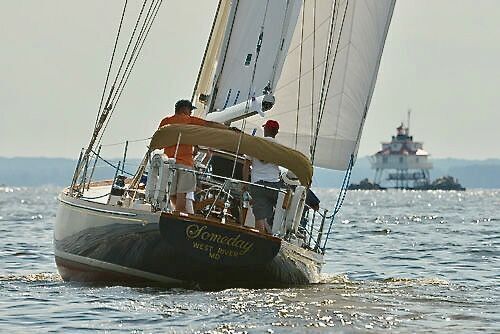


Sailors of all types and experience levels will hope they are on even keels and that they have fair winds this weekend as they take part in the 52nd annual Governor’s Cup sailing race.
The St. Mary’s College of Maryland tradition, which is the oldest overnight race on the Chesapeake Bay, features a 68.6 nautical mile race from Annapolis to the college.
There are also two other satellite races, each of which is about 48 miles in length.
“I’m always excited for the Governor’s Cup to return,” said Race Director Rick Loheed, who is also the St. Mary’s College associate director of the waterfront.
Boats departed Annapolis beginning 3 p.m. Friday and, depending on winds and other variables, are scheduled to arrive at the college early Saturday morning.
“There’s something special about sailing back to the college you graduated from,” said Michael Woolen of Baltimore, who graduated from St. Mary’s College in 2014 and has taken part in the race about five times. “And there’s something special about sailing overnight, assuming the conditions are advantageous.”
Other options include the Potomac leg, which runs from Dahlgren, Va., to the college.
“They will sail to a marker at the mouth of the Potomac where the river is widest and then come all around to the ‘SM’ marker,” Loheed said, adding that heading up the St. Mary’s River is “a completely different challenge than sailing down the bay.”
There is also a Solomons leg which has three entries this year.
“The Annapolis [leg] is more challenging because of the bigger distance and more water,” Loheed said, “but they’re all challenging and you’re sailing at night.”
There are 81 boats competing this year, which Loheed said “is on par with post-pandemic years.”
Loheed will be pulling double duty as he will be sailing in his third Governor’s Cup aboard his 35-foot Poor Richard, which will depart from Annapolis and compete in the CRCA Class.
“The more crew you have, the more righting movement you can have because they can all sit on the rail,” Loheed said. “Many of these boats have heavy weighted keels. But by adding weight to the windward rail you help the righting moment of the boat fight against the sails trying to tip it over, so you’re able to use a little more of that sail power to propel you forward a little faster.”
Crew members will serve as bow, main trimmer, jib trimmer, helmsman and sewer guy, which is so named because they pack up spinnakers down in the cabin. Loheed will be the tactician.
“It’s a challenging, grueling race,” Loheed said. “A lot of times those faster boats overtake us and sometimes that happens during the day, but it also happens at night. The whole race is a challenge. You’re constantly watching the Automated Identification System for other boats and as you go down the bay you have to make sure you’re aware of the ships. They are much faster than most people realize.”
He said the secret to having a successful race is “don’t make any mistakes.”
Woollen, who is planning on competing in the Annapolis leg aboard Jester in the PRFA Class, said that “most of the time sailing the rhumb line (the shortest point between A and B) is the fastest way in my experience. I think only one year has that not been the winning recipe.”
For more information on the race, visit .


(0) comments
Welcome to the discussion.
Log In
Keep it Clean. Please avoid obscene, vulgar, lewd, racist or sexually-oriented language.
PLEASE TURN OFF YOUR CAPS LOCK.
Don't Threaten. Threats of harming another person will not be tolerated.
Be Truthful. Don't knowingly lie about anyone or anything.
Be Nice. No racism, sexism or any sort of -ism that is degrading to another person.
Be Proactive. Use the 'Report' link on each comment to let us know of abusive posts.
Share with Us. We'd love to hear eyewitness accounts, the history behind an article.